
SuperChallenge on…Natural Discs
"Has This Disc Been Resurfaced?"
"Hi. Has this disc been resurfaced?"
It seemed like an innocent enough question from our customer.
An hour prior, he had bought and paid for a £15 Saturn game, which was advertised as being in pristine condition. The order had arrived just as we were processing shipping for the day, so the item was already boxed up and ready for collection the next morning by Blinky, our trusty Royal Mail postie. We didn’t give him that nickname, but the other three chaps who collect from us periodically understandably still don’t like it when we call them Pinky, Inky, and Clyde.
We don’t keep records of which discs we have resurfaced, as we don’t see a need to do so. We just sell beautiful, tested discs. Even still, we unpackaged the item and gave it a once-over. Not a mark on it. No resurfacing compound residue. No swirl marks. No marks at all, in fact. The disc was, as advertised, in pristine condition. We communicated this to the customer, adding the caveat that since we don’t keep records and didn’t purchase the item new from a store 30 years ago, it’s impossible for us to determine if the disc has ever been resurfaced.
At which point, the customer decided to cancel their order and request a refund.
Introducingthe "Natural" Disc Collector
As it turns out, this gentleman was collecting in a way that we hadn’t ever seen before. We thought no more of it.
But over the following weeks, we got more enquiries that were along the same lines. On further investigation, as unique as we’re sure this chap is, he’s not one-of-a-kind when it comes to his collecting preference. It turns out that there are collectors out there who flat-out refuse to buy a game disc if it has ever been resurfaced. They’re on the hunt for what are being termed “natural” discs, and judging by the listings and sales on eBay, boy, will they pay up for them. We’re not talking a small markup, either. It must have been at least 24 years since somebody paid £35 for an open PAL copy of Devil May Cry (a title that routinely sells for less than £10) on PS2, but they’ll seemingly pay it today for a natural disc.
What Are They Even Paying For?
At this point, we should probably clarify that, frankly, we don’t get it.
Traditionally, you have the gamers who will buy an item in any working condition, regardless of whether it even has a case or manual. They just want to play the game. Then there are those who would like a box or case, so it’ll look nice on their shelves, but they don’t care about stuff like registration cards or inserts. Then there’s the CIB (“complete in box”) crowd, who want a case, the game, and a manual, but can live without the odd piece of extra advertising that would have been in the box. The CIB+ crew wants everything to be included, as if it were purchased from the store that day, including registration cards, spine cards, and manual inserts. Beyond that, you have your sealed and graded collectors who are looking for decorative or investment pieces.
We understand the reasoning behind these tiers and levels and strive to cater to as many of them as possible.
But paying way over the odds for “natural” discs? That leaves us scratching our heads.
Can You Even Tell the Difference?
Firstly, if you hold up a “natural” disc next to one that we have resurfaced, you can’t tell the difference between them. Sure, some will claim that they’re an optical media savant who can “always tell”, but the fact of the matter is that if done correctly, resurfacing is an invisible process. Some will claim that the thickness of the disc gives things away, but, as we discussed in our other resurfacing article, the thickness of a brand-new disc can vary pretty wildly. You can measure two factory-fresh copies of the same title and find that the discs are of a different thickness, with the variation potentially being way more than would be caused by resurfacing.
Now, we’re aware that not all sellers do it properly. Some have lower-tier resurfacing machines. Some don’t maintain their equipment. Some don’t inspect their products before selling them. In those cases, sure, the difference can be as plain as day. Yet another reason why sticking with a seller you can trust and not just screaming “lowest price wins!” every time is your best move. Hint, hint.
What Do Sellers Actually Know?
Secondly, you need to consider what the seller truly knows. In our initial conversation with the buyer, we clearly stated, “We don’t know” when he asked if the disc had been resurfaced. Because…well…we don’t know! Our stock primarily comes from collection buys. If we buy a collection of 30-year-old video games, there could be items in that lot that have been owned by two, three, five, ten, or twenty people. Or more! As a seller, how can we determine if the third owner of a copy of Wing Arms accidentally scratched the disc and took it to their local game store for buffing? How can we tell if the store that sold a copy of Daytona USA to a guy we bought a lot from doesn’t resurface all their discs as a matter of course? Simply, we can’t.
The ”first owner” argument doesn’t hold water, either. We receive titles all the time that include the original faded purchase receipt, right there in the case. We could claim that we just happened to be on holiday in Tokyo back in ’98 and picked up this copy of Radiant Silvergun off the shelf on launch day and never resurfaced it, so there’s absolutely no chance that it isn’t a natural disc. Money, please!
For these reasons, this type of collecting is ripe for, shall we say, less scrupulous sellers to take advantage. You’re paying up based on the word of somebody that you don’t know, whose word can’t be disproven in any specific way.
What This Does to the Market
To clarify, although we at SuperChallenge aim to make a profit (albeit a modest one), we consider ourselves importers, artisans, collectors, and historical preservationists, rather than traditional resellers.
Whether you believe that to be nonsense or not, resellers are often criticised for being ruthless profiteers who would gladly barge their grandmother out of the way if it meant they could make an extra bit of profit on an item. After visiting a local gaming market this past weekend, it’s tricky to disagree with that appraisal.
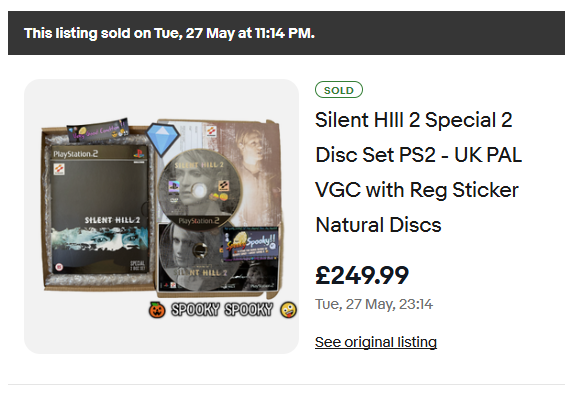
But then you have a group of folks who are happy to pay way over the odds for what amounts to snake oil. When resellers pick up a PS2 copy of Silent Hill 2 and see a bunch of sold listings for £65 and one otherwise identical “natural discs” listing that sold for £250, what do you think will happen? Many of them are already waiting to take advantage of collectors at every opportunity. Surely there’s no need for us to bend over and pull our cheeks apart in anticipation collectively?
Is There Any Logic to It?
Of course, all our arguments could (kind of) be negated if the reasoning for owning “natural” discs was a good one. However, although multiple reasons are frequently given, none of them are. If the resurfacing was done correctly, a repaired disc isn’t going to play any differently from a new copy. It isn’t going to look any different, unless there’s damage to areas of the disc that don’t form part of the playing surface, and even a natural disc can have that going on. It isn’t going to turn into dust any quicker than a new copy. A natural disc won’t preserve the laser on your console in any way. And since nobody can tell the difference between a natural and resurfaced disc, it won’t even impress anyone.
If anything, saying “I just paid £100 for a copy of the game that is identical to the one you bought last week for £30” is going to have the opposite effect.
How Far Are We Going With This?
Plus, where does it end? Are we going to get to the point that natural discs aren’t enough? Will some buyers be looking for natural discs that have never been wiped clean with a disc-cleaning cloth? Will we be able to charge more for natural discs that have never been removed from the case and which were oriented perfectly out of the factory so the title is the right way up? Are we going to pay a premium because the game manual has never been read or because a game was only ever used one time on a factory-fresh console? If natural discs cause a 3x-5x bump in price, then surely a game that was only ever handled by a dude wearing white gloves is worth a cheeky 10x?
Come on, now.
Where We Draw the Line
We've been asked to clarify whether discs are resurfaced or not in our listings, and we will not be doing that. It adds extra overhead to our inventory and processing systems and that's time that can be better spent elsewhere.
To clarify our position, we’ve already reached our line in the sand for classifying items. People wanted photos of game spines. We started doing it. Despite the photographic limitations of doing so, people wanted photos of both sides of the disc. Even though we gave grades to discs, our words meant nothing, so we got on board. People wanted shots of manuals outside of the game case. No problem. People wanted photos of inserts and registration cards. Sure! One guy wanted us to disassemble memory cards and photograph the internals to prove they were authentic. For some reason, we complied. People wanted photos of both sides of the spine card. Okey dokey. But that’s our limit.
We sell good stuff that works. We photograph everything. We give an overall condition grade and a disc grade, give condition notes, and have a fair returns policy. We won’t be marking items as “natural” or “resurfaced”, providing import papers, signed letters of first ownership from guys in Tokyo, or blurry 240p CCTV footage of us buying the game at retail in 2002.
We already go so far above and beyond compared to many other sellers. At this point, all we can really do is throw our hands up in the air and say “We love you, but either what we're doing is enough to convince you to buy the thing, or it isn't."